Day 43. Samoa
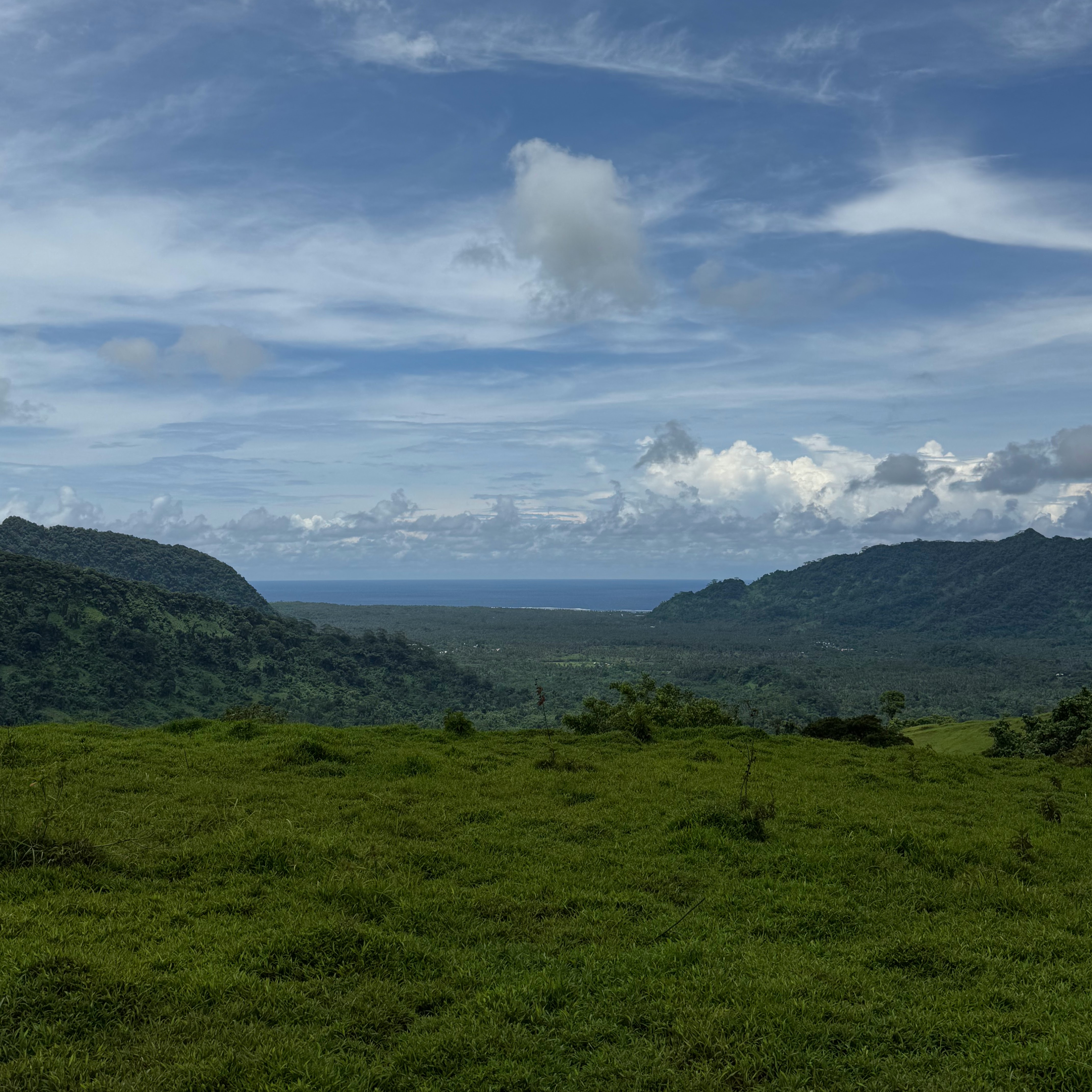
Timezone: UTC+13.
If ever you should suffer from nervous prostration, I advise you to come to Samoa; to these green, quiet islands of the South Pacific, far away from the hustle and bustle of our nerve-wrecking civilization. Here no shrill locomotive whistle makes you jump and wince; no telephone bells call you away from your dinner; you never have to hurry to catch a train or a tram-car, for there are no trains or tram-cars to catch; never would a telegram startle or frighten you, for no electric line connects these happy islands with the rest of the worrying world. The only excitement is the arrival of the American-Australian mail steamers once a month; then you get your mail, after which you have again a whole month before you, with nothing to do but answer letters, breathe, sleep, and eat. Is this not an inviting prospect for any one whose nerves suffer at every noise and shock? Add to this that you would have to deal with the handsomest, most charming, and gentlest of savages.
Yes, the Samoans are all this. I can understand now Robert Louis Stevenson's love for them. If I were not spoiled by civilization, I would settle down among them and live their simple Arcadian life. But, unfortunately, I am spoiled, irrevocably spoiled, by many years of an artificial life. I do want to be worried by dress-makers and milliners; I do want to build palaces in the air; I do want to work, to plan, to hurry so as to get ahead of some of my fellow-creatures. In one word, I do want to be miserable. What a lesson of happiness I could learn from the Samoans, if I wanted to! They eat what nature and their neighbors' plantations kindly provide them with — bread-fruit, taro, bananas, cocoanuts, etc.; they dress in nothing; they dwell in houses composed of four poles and a thatched roof; they sleep on mats with bamboo sticks for pillows; all these things are easy to get. They do not have to kill themselves with hard work to get a living, as is so often the case with us clever and wise people.
If the Samoans are so hapny and gentle, you will ask, why are there so many rebellions in Samoa? My dear, what human being would not rebel if he had three masters and was expected to serve all three well, but each in a different way? Well, that is about the case with Samoa. The three great powers, America, England, and Germany, have all set their foot here, and all want to have their say in matters of government. Of course you do not imagine that they often agree. Strange to say, none of the three powers seems particularly anxious to get the islands for itself, and yet none of them wants to retire, leaving the others in peaceful possession. So far, I believe, the Germans have the greatest hegemony in Samoan affairs; they possess most of the land — the immense cocoanut plantations — and the Samoan commerce is entirely in their hands. They have the king under their thumbs; he, poor man! does not dare to move without their permission. Onthe other hand, the English seem to have a greater hold on the people, for it is England which Christianized and taught them.
The German consul-general, in speaking to me of their tripartite government, said that the Germans would willingly withdraw from the islands if some one would buy their plantations at a fair price. I wonder whether he meant it. When I asked the English consul, “Why does not England try to get these islands? John Bull is not generally so timid about getting things that do not belong to him,” his answer was very English: “It would be too expensive an acquisition, for Samoa has neither gold, silver, nor precious stones.”
His explanation was very clear to me. If Samoa were one of the gold or diamond districts of South Africa, both Germany and America would long ago have received their passports.
That the possession of Samoa, in spite of the fertility of the soil, would not enrich a country I can easily see. The Samoans will not work for the whites, except, perhaps, for the missions; so laborers have to be imported from other islands. Moreover, Samoa will never be a white man's country like New Zealand or Tasmania: it is too hot for those who have to work. True, I began by recommending it, but only to the sick and to those who wished to come here for a rest. The climate seems to be especially hard on women and children ; they cannot stand it long, and therefore most white men here are bachelors or married to native women. If things go on like this, Samoa will soon have a population of half- whites only, and that will be a great pity; for while the Samoans have charming qualities, this is not the case with the metis or mixed blood. They seem to take the very worst of both races. That French priest was not far wrong when he said, “God made the white man, and God made the black man, but the devil made the metis.”
Last week my friend from the mission school and I called on His Majesty, King Maleatoa Luapepa. He received us in his European villa, a house not much more than a cottage with half a dozen rooms. His income does not allow him to live in grand style. When his subjects pay their taxes regularly he gets seventy-five dollars a month; but if they do not, which is more often the case, he receives only fifty dollars. You see it does not pay to be king in Samoa. King Maleatoa is a very nice man, about fifty years of age, educated by the missionaries, and a member of the Congregational Church. He has had a sad and an adventurous life for a Samoan king. In 1888 the Germans took him prisoner and sent him to Cameroon, Africa, where he was confined for three years. During his captivity he was ill with yellow fever, from which he never quite recovered. He appears sad and broken down. In looking at him you would never think of saying “happy as a king.”
Lina Bögli, “Forward. Letters Written on a Trip Around the World”