Day 7. The Atlantic Ocean
Timezone: UTC-2.
A good start to the day with a Christian fellowship gathering – one that is set to become a fixture of our oceanic crossing. After a round of introductions, a former pastor from the States gave a powerful impromptu sermon on a few verses from the Epistle to the Hebrews. Some participants shared their own impressions. Fellowship is important, and I am so glad for it.
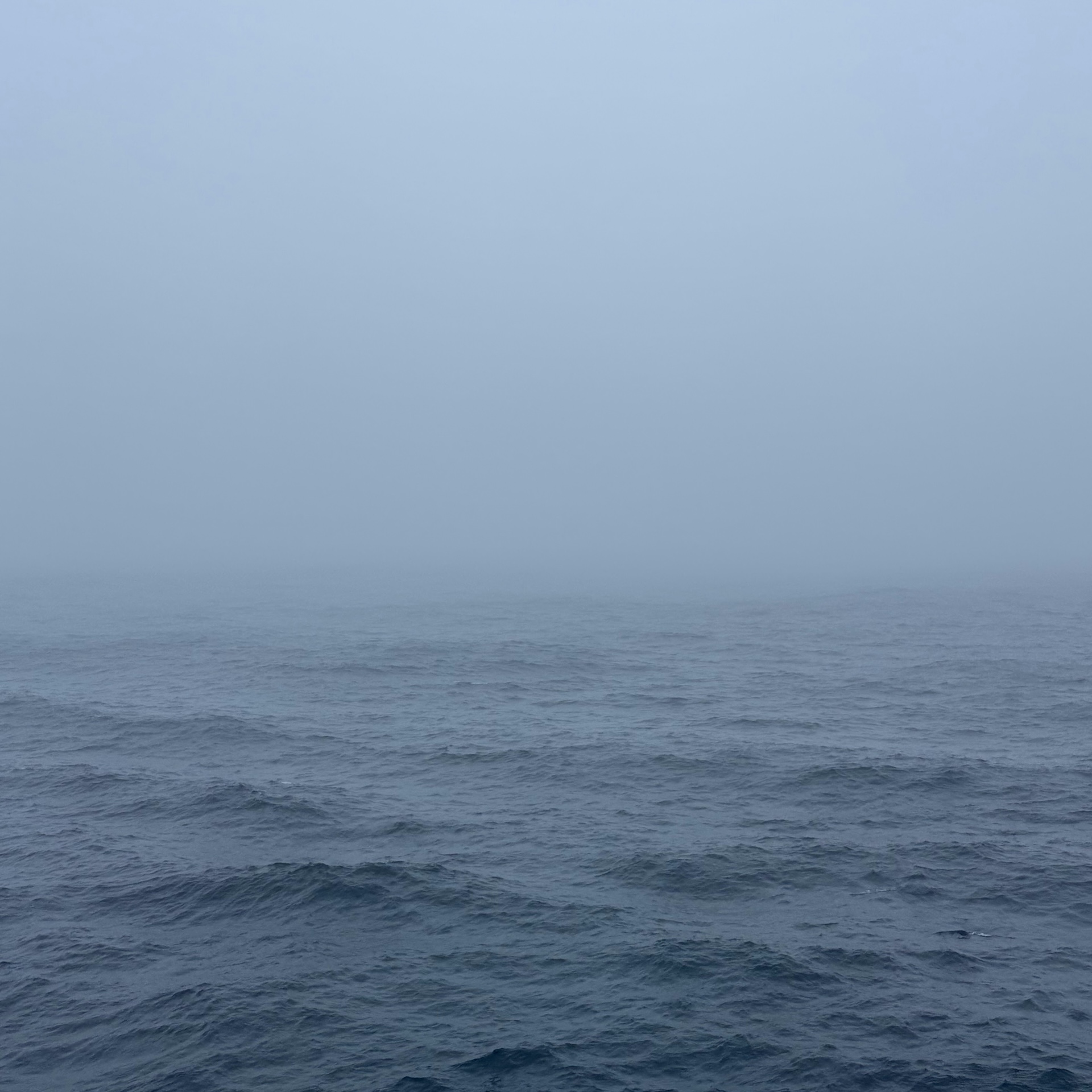
The promenade deck is made for walking, but just as much for great conversations. As the Atlantic turned really misty, I had a long chat with a charming German American scholar of music – about Bach's cantatas and “The Art of Fugue”, Monteverdi, Telemann's Rostock manuscript, Scarlatti's St. John Passion, and the pace of the world. She made the claim that Richard Wagner is very dangerous, but also rather engrossing. No disagreement there. We promised we would catch one another once again at tea or elsewhere, although I wonder if that is going to be possible in this floating town. Another German encounter at the staircase – an elderly couple. The husband seemed very, very angry at his wife for walking too slowly, to the point of raising his voice rather abruptly. She seemed to suffer from an injury or a disability, as one often does at her age. It would seem I observed a small cross-section of the German soul today. Gentleness and violence. I cannot help but notice that the gentleness was a New World émigré.
My dinners continue to be enjoyed with great company, but I also use them as an opportunity for some people-watching, a beloved pastime of mine. I notice many couples at tables do not talk to one another. I really hope they have simply mastered mind reading and exchange affection subliminally.
The ocean – the scale of which is truly captivating, not unlike Westminster Abbey – is becoming more agitated, and I am sure it will only get better/worse (delete as appropriate). The ship has been shaking quite a bit, and its interior structures have been producing sounds of a growing variety. But I know where my life jacket is – in the sky!
News of the loss reached New York first via the Vaterland's powerful radios which, although prohibited from transmitting, were allowed to receive and picked up triumphant German bulletins. One of her German crew relayed the news to a newspaper reporter in a Hoboken bar who in turn alerted Charles Sumner, Cunard's New York manager. The loss of nearly twelve hundred lives aroused public indignation throughout the world and is popularly credited with bringing America into the war. If this is perhaps an oversimplification, it would not be inaccurate to say that the incident led to a rude awakening on both sides of the Atlantic. In America, the European War, as it was called at that time, took on ominous significance.
With the realism forced on us by two World Wars, it seems the height of naïveté for the British to have presumed that one of their fastest ships could steam with impunity on an announced schedule through hostile waters. To generations who have seen saturation bombing of civilian targets, the contemporary disclaimer that the ship was not involved in hostilities borders on the ludicrous. For, even though the Germans had laid Belgium to waste, even though civilian casualties were already a reality, there was a cherished delusion that war, however frightful, could be confined to confrontations between armies and fleets. Its extension to include noncombatants was incomprehensible in the spring of 1915. The Lusitania's destruction marked a loss of innocence nurtured by too many years of peace. Especially galling was the celebration that Schwieger's kill triggered in Germany. The Kaiser declared a national holiday and crowds thronged the streets of Berlin. In Munich, a commemorative medal was struck, one side showing passengers lined up at a guichet under the legend “Business As Usual” and on the reverse, a representation of the sinking liner loaded with armaments.
In London and other port cities, furious mobs sacked and burned German shops. Still kept in Cunard's vaults to this day is a collection of reports forwarded on by the Royal Irish Constabulary in an attempt to identify some of the Lusitania's dead. One photograph shows a seven-year-old boy washed up on an Irish beach. An accompanying text describes “number four“, as he was called, as wearing a blue Lord Fauntleroy suit, with black stockings, one of which was held up by a piece of string instead of a garter; in his lapel was a Lusitania souvenir pin. It is difficult to believe that the catastrophe responsible for his death was the occasion for his German contemporaries to be given a holiday.
John Maxtone-Graham, “The Only Way to Cross: The Golden Era of the Great Atlantic Liners”